Lottie’s Christmas Eve heart emergency and rescue
All My Puny SorrowsLottie’s Christmas Eve heart emergency and rescue turns a familiar family fear into a holiday gathering: Lottie’s breathing changes at home, emergency treatment saves her, and her daughters spend Christmas Eve with her in hospital. The episode also reveals how routine this danger has become for the family. Lottie is not only the person in need of care; she is the mother who has repeatedly stood up for her daughters, and even in hospital she makes room for humour, conversation, and a meal shared together.
Background and the journey to hospital
On Christmas Eve, the household is dispersed. Will and Zoe have left early for Mexico City, Nic is in Montreal, and Nora is speaking over Skype with Anders, who is in Stockholm for the holidays. Yolandi is reading in Lottie’s living room when she notices that her mother is making unusual noises. Lottie is lying close to the Christmas tree, breathing shallowly and exhaling in a way that Yolandi recognizes as alarming. She calls an ambulance, and the family goes to hospital.
The speed of the transition—from a quiet room and a book to an ambulance and emergency care—places the crisis inside the ordinary arrangements of a holiday. The scene does not dwell on a diagnosis. Instead, it follows what the family can see and do: Yolandi recognizes that her mother may be dying, calls for help, and accompanies her to hospital. There, medical staff revive Lottie by pressing on her chest and giving her nitroglycerine and other strong medication to help her overworked heart. Her survival is immediate and concrete: the family has brought her in, and the hospital saves her life again.
A hospital unlike the one Elfrieda knew
For Yolandi, the emergency room is familiar, but the kind of case matters. Lottie is treated as a cardiac patient, not as a psychiatric patient. Yolandi contrasts the care Lottie receives with the scolding and demands for compliance that have marked Elfrieda Von Riesen’s hospitalization. In Lottie’s case, the family encounters no staff lecture about behaviour; the difference sharpens the story’s attention to how a hospital’s response can change with the category assigned to a patient.
This contrast has particular force because Lottie has recently challenged the treatment of Elfrieda. She objects when staff expect her daughter to cooperate as a condition of care, insists that Elfrieda is a human being, and defends her right to eat or speak on her own terms. Lottie’s own emergency therefore places her on the other side of the family’s caregiving pattern: now her daughters sit beside her while she is vulnerable. Yolandi’s earlier fear that hospitals might let a loved one go also carries a family precedent. She recalls that she and Elfrieda had pleaded with a hospital not to release their father, but he was released and was gone for good. The Christmas rescue answers that old helplessness differently: this time, Lottie is brought in and survives.
Christmas Eve behind the curtain
Even in the emergency department, Lottie turns the crisis toward humour. She jokes to the paramedics that the episode is enough to jar her mother’s preserves; one paramedic asks her to repeat the line so he can tell his friends. The joke does not undo the seriousness of the medical emergency. Instead, it shows Lottie making a familiar social connection at a moment when the family could otherwise be defined entirely by fear.
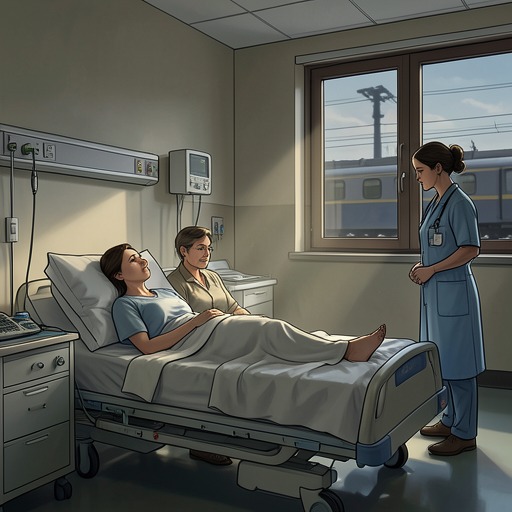
Nora comes to the hospital, and she and Yolandi sit on either side of their mother. Lottie lies behind a brown curtain, connected to machines and drips, and sleeps. When she wakes, she remarks on the predicament of spending Christmas Eve in hospital. She tells her daughters that she has dreamt of Amelia Earhart. In the dream, a man called Earhart his favourite missing person. Lottie cries briefly, then apologizes for being in hospital over Christmas, recalling the way Elfrieda had apologized to an uncle for being in psychiatric care. Her daughters hold her hands and reassure her that the holiday can be celebrated another time, with the Ukrainians in January.
A neighbour, Amy, brings food, wine, cloth napkins, china, and silver cutlery. The family lays out Christmas Eve dinner on Lottie’s stomach, making her the table as well as the reason everyone has gathered. Nora briefly removes Lottie’s oxygen mask so she can take a sip; the nurse has allowed one, but Lottie has two. They drink champagne from plastic sample cups and toast Lottie’s family members, including Elfrieda, their father, Tina, and Leni, as well as the nurse who has treated them kindly. They sing Lottie’s favourite Christmas song, I Wonder as I Wander. The scene makes celebration neither a denial of danger nor a substitute for treatment: it takes place in the emergency room, around a mother whose life has only just been saved.
Recurrence and the meaning of rescue
Yolandi stays with Nora until Lottie has fallen asleep, then goes home. On Christmas Day, Lottie is already entertaining fellow patients with anecdotes from behind the brown curtain. The narrative describes her as someone who is always dying, at least once a year, and lists emergency rooms she has passed through, from Puerto Vallarta and Cairo to Winnipeg, Tucson, and Toronto. This recurrence gives the Christmas Eve episode its particular weight. The rescue matters, but it is not presented as a final end to the danger; it is another reprieve in a life repeatedly interrupted by medical crises.
When Yolandi returns, Lottie asks her to move the things from a chair and sit beside her. She places her open whodunit face down on her chest so she will not lose her place, takes Yolandi’s hand, and begins to say that there is something she wants to tell her. The narrative pauses before disclosing what follows. Within the episode, that unfinished opening shifts attention from the machinery of emergency care to the relation at its centre: a mother who has survived, a daughter who has come back to her bedside, and a moment of conversation still to come.